For schools
Striqr for schools
Pupils run code in Discord and on striqr.com, every try is checked, and the results line up against the National Curriculum and the GCSE specifications. One press to set up a class, hints instead of answers, nothing to install.
Mapped to the National Curriculum for England (key stage 3 computing) and to the OCR J277, AQA 8525 and Pearson Edexcel 1CP2 GCSE Computer Science specifications.
Striqr isn't approved by the DfE, which approves nothing of this kind, and isn't endorsed by an exam board. The mapping is published below, statement by statement, so you can check it against your scheme of work.
Challenges with tests, checked privately
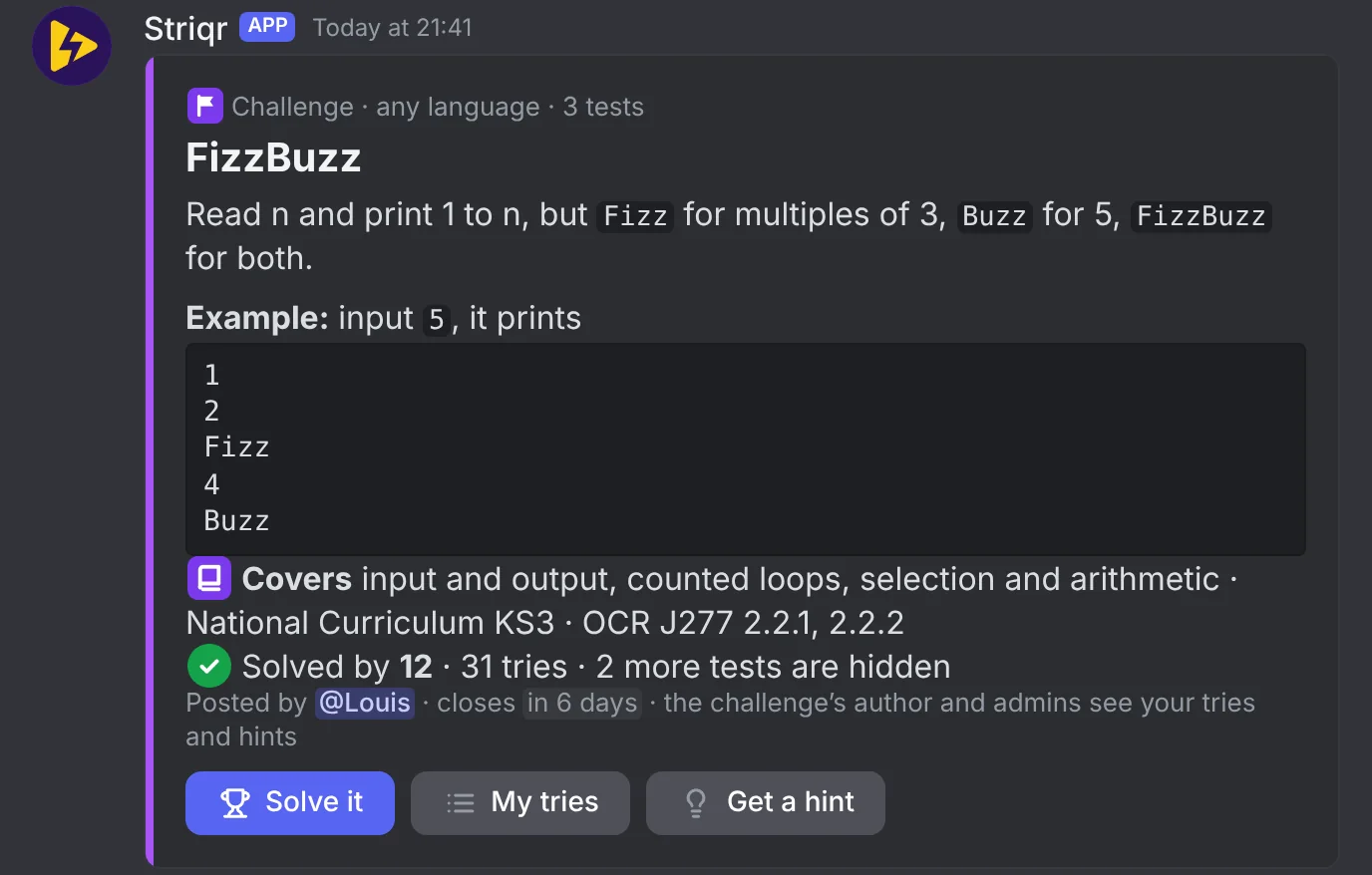
Post a ready-made challenge, or your own with your answer. Pupils press Solve it, and each try runs against the tests, privately. The card says what the challenge covers, in plain words and in your board's codes, so everyone sees what they are practising.
Each pupil sees their own progress
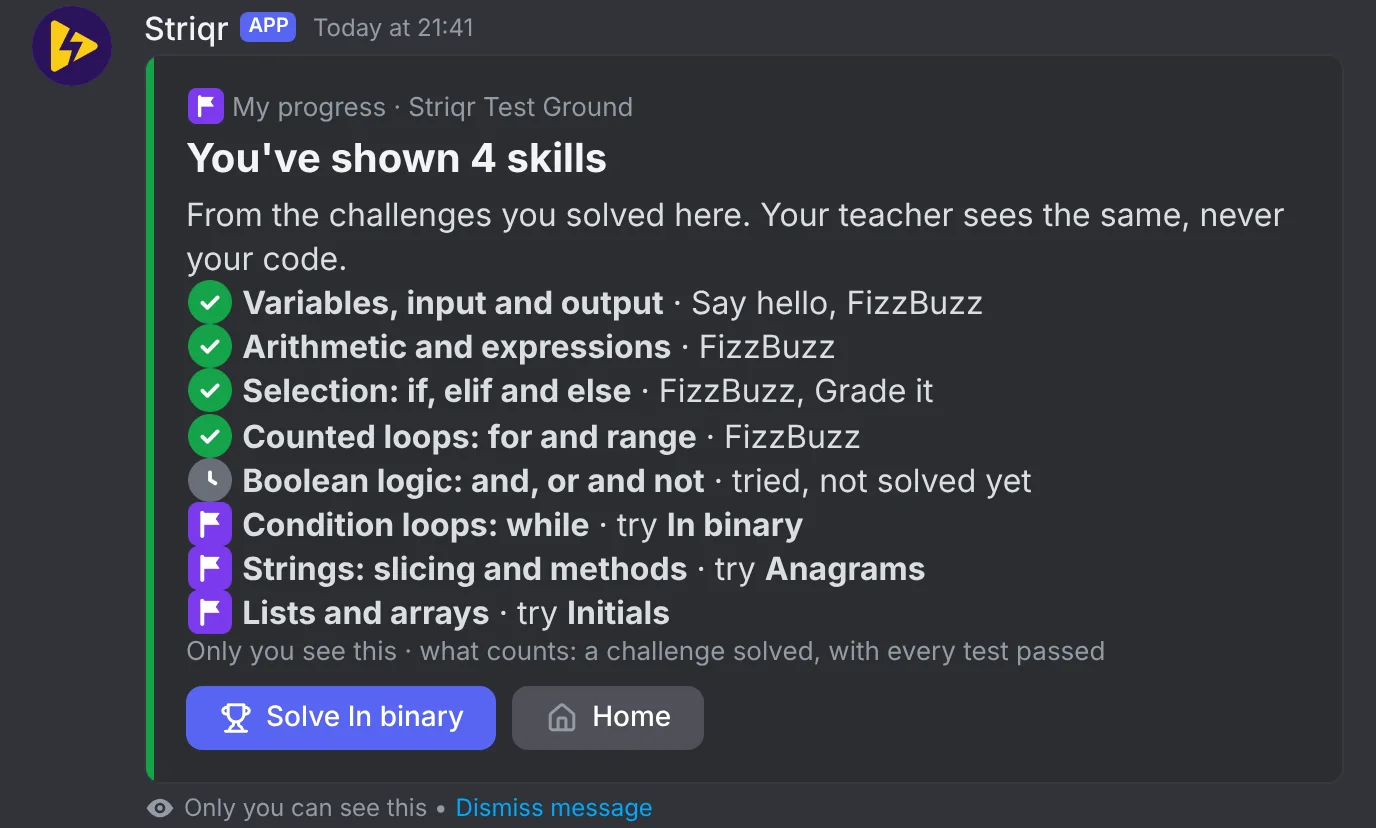
My progress on Home shows a pupil the skills they have shown by solving challenges, what they tried, and the next challenge to try. In their language. They never see anyone else's, and you see the same evidence as a class.
Fill a gap in a minute
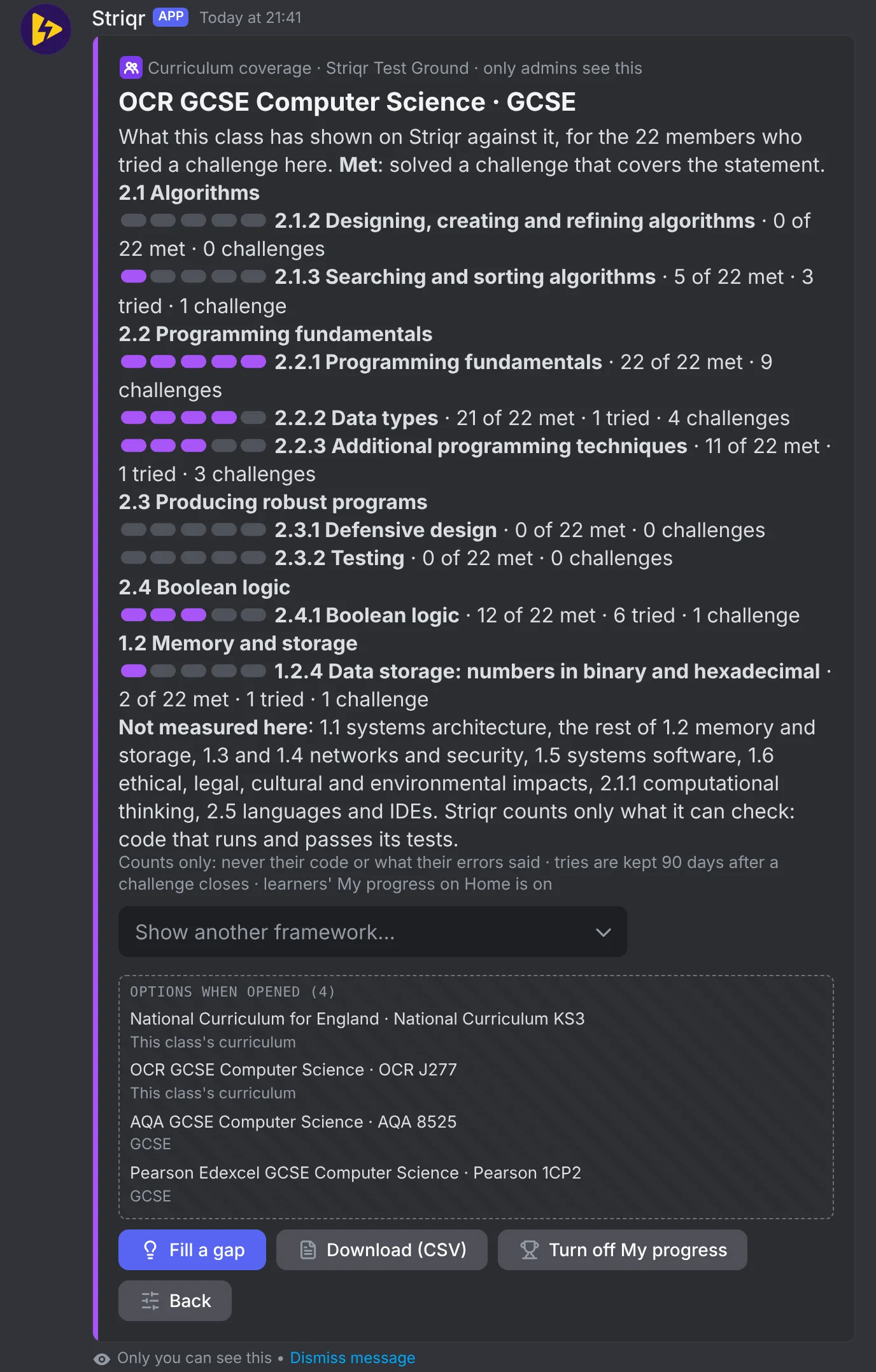
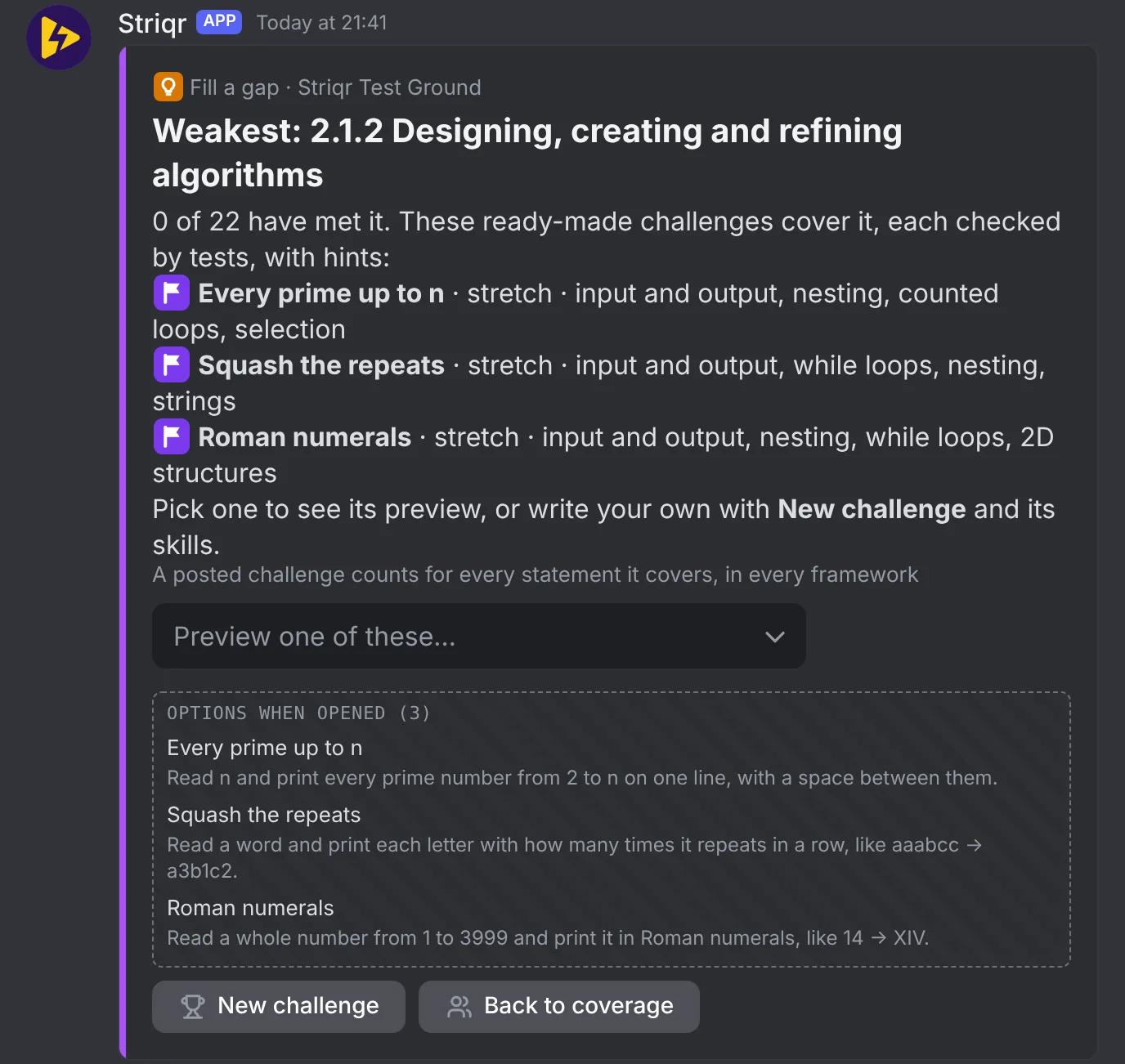
Coverage names the statement fewest pupils have met and lists the ready-made challenges that cover it, each already checked by tests and with hints. Pick one, read its preview, and post it. The whole class's picture is at striqr.com/classes, with a CSV and a page to print.
How it works in a class
-
Make the class server
Start one from our template, or add Striqr to a server you already have.
Add to a server -
Run /setup and pick A class
Class mode turns on: the Start here panel, a help channel, results to each pupil first, hints instead of answers.
-
Pick the curriculum
On the Class mode card, pick what the class follows: the National Curriculum, OCR, AQA or Pearson Edexcel, up to two.
-
Post a challenge
A ready-made one, or your own. Each solve counts towards the statements it covers, in Discord and on striqr.com/classes.
Built for a classroom
-
Hints, not answers
Class mode turns learning mode on: Striqr AI explains and hints, and never hands out the fixed code. A hint says what is wrong, where to look, and a question to think about.
-
Results come to each pupil first
Runs and answers are private until a pupil presses Show everyone. Ask for help posts a failed run to your help channel, so classmates can answer.
-
Keys and tokens stay private
Striqr asks before anything with a key or a token in it goes public, and takes keys out of the code it keeps.
-
A Discord account is all a pupil needs
No Striqr account, no install, nothing on the school's computers. Discord's own age rules apply, so it suits key stage 3 and up.
-
Pearson's Python subset
In a class that follows Edexcel, a solve's result names what the code used outside the Programming Language Subset, with the line. It never costs a mark.
-
The editor says what a file shows
Turn on AI fixes on striqr.com in Class mode. A Python file opened from the server then gets a Smart Bolt tip: the skills it shows and the codes they count for. In an Edexcel class, what sits outside the subset too, with the line. Read in the browser: nothing leaves the page.
-
A weekly summary for staff
Once a week, one card in your admin log: this week's challenges, who may need help, and what pupils got stuck on most.
-
Evidence to print
striqr.com/classes shows the heat map, one row a statement and one column a pupil, with a CSV and a page laid out for a department review.
-
Counts, never code
Coverage is read from the tries the challenges already keep. The bot sends striqr.com counts, Discord ids and display names, and nothing a pupil wrote.
-
Striqr AI with a safety text
Every Striqr AI answer carries the school-safe text in its instructions, and Ask Striqr AI answers in the pupil's language.
The mapping
Every ready-made challenge is tagged with the skills it shows. One table says what each skill counts for in each framework. A statement is met when a pupil solved a challenge that shows one of its skills, with every test passed. What Striqr can't check is named, never claimed.
- Met: a challenge solved whose skills cover the statement. Tried: tried, not solved yet.
- Only what runs counts: code that passed the challenge's tests. Hints never count against anyone.
- Statements Striqr can't evidence (networks, hardware, trace tables on paper) are listed as not measured on every page.
- The map is versioned. England's new national curriculum, due to be taught from 2028, is one more column, not a rewrite.
National Curriculum for England
| Statement | Evidenced by |
|---|---|
| Algorithms | |
| Understand several key algorithms that reflect computational thinking, such as ones for sorting and searching | searching, sorting |
| Use logical reasoning to compare the utility of alternative algorithms for the same problem | efficiency |
| Programming | |
| Use a textual programming language to solve a variety of computational problems | input and output, arithmetic, selection, counted loops, while loops, nesting, strings, validation, authentication, files, random numbers, debugging |
| Make appropriate use of data structures, such as lists, tables or arrays | lists, 2D structures |
| Design and develop modular programs that use procedures or functions | functions |
| Logic and data | |
| Understand simple Boolean logic (AND, OR and NOT) and some of its uses in circuits and programming | Boolean logic |
| Understand how numbers can be represented in binary, and carry out simple operations on binary numbers | binary |
Not measured here: computational abstractions; hardware, software and networks; how instructions and data are stored; creative projects and digital artefacts; using technology safely. The specification.
OCR GCSE Computer Science
| Code | Statement | Evidenced by |
|---|---|---|
| 2.1 Algorithms | ||
| 2.1.2 | Designing, creating and refining algorithms | nesting, tracing code, debugging |
| 2.1.3 | Searching and sorting algorithms | searching, sorting |
| 2.2 Programming fundamentals | ||
| 2.2.1 | Programming fundamentals | input and output, arithmetic, selection, counted loops, while loops, Boolean logic |
| 2.2.2 | Data types | arithmetic |
| 2.2.3 | Additional programming techniques | strings, lists, 2D structures, functions, files, random numbers |
| 2.3 Producing robust programs | ||
| 2.3.1 | Defensive design | validation, authentication, readable code |
| 2.3.2 | Testing | debugging |
| 2.4 Boolean logic | ||
| 2.4.1 | Boolean logic | Boolean logic |
| 1.2 Memory and storage | ||
| 1.2.4 | Data storage: numbers in binary and hexadecimal | binary |
Not measured here: 1.1 systems architecture; the rest of 1.2 memory and storage; 1.3 and 1.4 networks and security; 1.5 systems software; 1.6 ethical, legal, cultural and environmental impacts; 2.1.1 computational thinking; 2.5 languages and IDEs. The specification.
AQA GCSE Computer Science
| Code | Statement | Evidenced by |
|---|---|---|
| 3.1 Fundamentals of algorithms | ||
| 3.1.1 | Representing algorithms | tracing code |
| 3.1.2 | Efficiency of algorithms | efficiency |
| 3.1.3 | Searching algorithms | searching |
| 3.1.4 | Sorting algorithms | sorting |
| 3.2 Programming | ||
| 3.2.1 | Data types | arithmetic |
| 3.2.2 | Programming concepts | input and output, selection, counted loops, while loops, nesting, readable code |
| 3.2.3 | Arithmetic operations | arithmetic |
| 3.2.4 | Relational operations | selection |
| 3.2.5 | Boolean operations | Boolean logic |
| 3.2.6 | Data structures | lists, 2D structures |
| 3.2.7 | Input/output | input and output |
| 3.2.8 | String handling operations | strings |
| 3.2.9 | Random number generation | random numbers |
| 3.2.10 | Structured programming and subroutines | functions |
| 3.2.11 | Robust and secure programming | validation, authentication, debugging |
| 3.3 Data representation | ||
| 3.3.2 | Converting between number bases | binary |
| 3.3.4 | Binary arithmetic | binary |
| 3.4 Computer systems | ||
| 3.4.2 | Boolean logic | Boolean logic |
Not measured here: the rest of 3.3 data representation; the rest of 3.4 computer systems; 3.5 networks; 3.6 cyber security; 3.7 relational databases and SQL; 3.8 impacts of digital technology. The specification.
Pearson Edexcel GCSE Computer Science
| Code | Statement | Evidenced by |
|---|---|---|
| Topic 1 Computational thinking | ||
| 1.1.2 | The benefits of subprograms | functions |
| 1.2.1 | Algorithms with sequence, selection, repetition and iteration | selection, counted loops, while loops |
| 1.2.2 | Variables, constants and data structures in algorithms | lists, 2D structures |
| 1.2.3 | Arithmetic, relational and logical operators in algorithms | arithmetic |
| 1.2.4 | Determining outputs and using trace tables | tracing code |
| 1.2.5 | Types of error, and correcting logic errors | debugging |
| 1.2.6 | Standard algorithms: sorts and searches | searching, sorting |
| 1.2.7 | Evaluating algorithms with test data | efficiency |
| 1.3.1 | Truth tables | Boolean logic |
| Topic 2 Data | ||
| 2.1.3 | Denary and 8-bit binary | binary |
| 2.1.4 | Binary addition and shifts | binary |
| 2.1.6 | Hexadecimal | binary |
| Topic 6 Problem solving with programming | ||
| 6.1.1 | Decomposition and abstraction in code | functions |
| 6.1.2 | Read, write, analyse and refine programs | input and output |
| 6.1.4 | Readable, maintainable code | readable code |
| 6.1.5 | Find and fix program errors | debugging |
| 6.1.6 | Evaluate programs with test data | efficiency |
| 6.2.1 | The structural components of programs | input and output |
| 6.2.2 | Sequence, selection, repetition and iteration | selection, counted loops, while loops, nesting |
| 6.3.1 | Data types and structures | arithmetic, lists, 2D structures |
| 6.3.2 | Variables and constants | input and output |
| 6.3.3 | String manipulation | strings |
| 6.4.1 | User input and output | input and output |
| 6.4.2 | Reading and writing CSV files | files |
| 6.4.3 | Validation | validation |
| 6.4.4 | Authentication | authentication |
| 6.5.1 | Arithmetic operators | arithmetic |
| 6.5.2 | Relational operators | selection |
| 6.5.3 | Logical operators | Boolean logic |
| 6.6.1 | Built-in and user-devised subprograms | functions, random numbers |
| 6.6.2 | Functions and procedures | functions |
| 6.6.3 | Global and local variables | functions |
Not measured here: 1.1.1 decomposition and abstraction as understanding (6.1.1 covers it in code); the rest of Topic 2 data; Topic 3 computers; Topic 4 networks; Topic 5 issues and impact; 6.1.3 converting algorithms into programs. The specification.
The ready-made challenges
| Challenge | Level | Skills |
|---|---|---|
| Say hello | Starter | input and output |
| Add two numbers | Starter | input and output, arithmetic |
| Even or odd | Starter | input and output, arithmetic, selection |
| The biggest of three | Starter | input and output, selection |
| Backwards | Starter | input and output, strings |
| Count the vowels | Starter | input and output, strings, counted loops, selection |
| Times table | Starter | input and output, counted loops, arithmetic |
| FizzBuzz | Starter | input and output, counted loops, selection, arithmetic |
| Same both ways? | Starter | input and output, strings, selection |
| Leap year | Starter | input and output, selection, Boolean logic, arithmetic |
| Countdown | Next | input and output, counted loops |
| Add up to n | Next | input and output, counted loops, arithmetic |
| The average | Next | input and output, lists, arithmetic |
| Grade it | Next | input and output, selection |
| Initials | Next | input and output, strings, lists |
| Count the words | Next | input and output, strings, lists |
| Celsius to Fahrenheit | Next | input and output, arithmetic |
| A triangle of stars | Next | input and output, counted loops, strings |
| The longest word | Next | input and output, strings, lists, selection |
| Add the digits | Next | input and output, arithmetic, while loops, strings |
| Minutes to hours | Next | input and output, arithmetic |
| Capital letters | Next | input and output, strings, lists |
| Multiples | Next | input and output, counted loops, arithmetic |
| Coins for change | Next | input and output, arithmetic, counted loops, selection |
| Prime or not | Stretch | input and output, counted loops, selection, Boolean logic |
| Every prime up to n | Stretch | input and output, nesting, counted loops, selection |
| Fibonacci | Stretch | input and output, counted loops, lists |
| Anagrams | Stretch | input and output, sorting, strings |
| Squash the repeats | Stretch | input and output, while loops, nesting, strings |
| In binary | Stretch | input and output, binary, while loops, arithmetic |
| Count each word | Stretch | input and output, 2D structures, counted loops, strings |
| The second biggest | Stretch | input and output, sorting, lists |
| Steps to 1 | Stretch | input and output, while loops, selection, arithmetic |
| Secret code | Stretch | input and output, strings, selection, counted loops |
| Balanced brackets | Stretch | input and output, lists, selection, counted loops |
| Greatest common divisor | Stretch | input and output, while loops, arithmetic |
| Roman numerals | Stretch | input and output, nesting, while loops, 2D structures |
| Smallest first | Stretch | input and output, sorting, lists |
Map version 1. Exam board text is quoted in the shortest form that identifies a point, with a link to the specification; the frameworks' documents are the boards' and the DfE's own.
Pearson Edexcel's Python subset
Paper 2 is an on-screen exam in Python 3, set within Pearson's Programming Language Subset. In a class that follows Edexcel, a pupil's solve result names what their code used outside it, with the line: an f-string, sorted(), a dictionary. So they practise within what the paper allows. The code still counts, and nobody else sees the note.
What it costs
Free to start: every pupil gets 25 runs a day, the error explainer, sharing, and 3 Striqr AI answers a day. Where it's on sale, a school buys the class plan in Discord for one server. That server then gets up to 400 runs an hour instead of 120. Coverage, My progress and striqr.com/classes are part of class mode on every plan.
What Striqr keeps, and who sees it
- In Discord, the bot keeps a pupil's last 5 pieces of code for 7 days, with keys taken out. A challenge try keeps its score and the skills it showed, never the code. Delete my data in /settings deletes a person's part.
- striqr.com keeps one snapshot a class server: counts, Discord ids and display names, the challenges' titles and the map. It is replaced on each send and dropped after a year without one.
- Only the admins who opened Coverage in the server, and the challenges' authors, can open the class at striqr.com/classes. Pupils see only their own My progress.
- Exports carry member numbers unless you ask for names. Striqr AI's answers are made by Anthropic's API and not used to train models.
- Your school is the data controller and Striqr the processor. Ask us for the data processing agreement and the privacy notice for parents.
The Privacy Policy says everything the bot keeps, and why.
Questions and answers
Which curricula does it map to?
The National Curriculum for England's key stage 3 programme of study, and the GCSE Computer Science specifications of OCR (J277), AQA (8525) and Pearson Edexcel (1CP2). A class picks up to two. Wales, Scotland and Northern Ireland are not mapped yet.
Is Striqr approved or endorsed?
No. The DfE approves no resources of this kind, and no exam board has endorsed Striqr. We publish the mapping so you can check it, and we will apply to OCR's endorsement process after a term of classroom use.
What does a pupil need?
A Discord account and your class server. Discord's own age rules apply (13 and over in most countries). Code opens on striqr.com from the server's links without an account.
Can I export evidence for a review?
Yes. striqr.com/classes has a CSV with member numbers, names a tick away. A page laid out to print or save as a PDF carries the date, the framework and what isn't measured.
What happens to the new national curriculum in 2028?
The content is tagged with skills, not spec codes, so the new curriculum is one more table when it is published in 2027. Your challenges and your pupils' tries keep counting.
Where does the code run?
On Striqr's servers, never on a pupil's device or the school's network. Each run gets a fresh container with no internet access.
Does Striqr AI write the homework?
In class mode, no. Learning mode gives hints and explanations and never the fixed code. It is best effort: a pupil can still reword a task, and the weekly summary shows who got stuck where.
Set up a class this week
Add Striqr to your server, run /setup and pick A class. Questions first? Write to us on the support page.
Add to a serverMore from Striqr
-
Code in the browser
Browser-native editor
Syntax highlighting, files, and a terminal. No install.
-
Fixes as you run
Smart Bolt
Spots a missing library or a wrong port, and offers the fix.
-
Build with AI
AI assistant
Plan features, edit files, and debug with top models.